
Indian railway stations are often large, busy, and full of long walking routes. You may need to move from the main entrance to a security check, then to a platform bridge, and finally to your train door. That is why many travelers ask whether an Airwheel electric suitcase can really help in these places. The short answer is yes, in many cases. It can turn a heavy rolling luggage into a slow rideable carrier when the floor is smooth and the crowd allows safe movement. However, it is not a shortcut in every area. In packed gates, narrow stairs, or uneven surfaces, hand-pulling is still the best choice.
Using the SE3T as an example, this Airwheel electric smart suitcase has a 73.26Wh battery, about two hours of charging time, and a range of 8-10km. Those numbers are practical for station travel because you rarely need to ride continuously for long distances inside one station. The main modes are ride, pull, and normal suitcase use. You can sit and move at a low speed, or pull it behind you when space is limited. With App control, you can guide forward and backward, while the handle helps you choose direction. A point users care about is independence from a phone. The basic riding function does not require app activation. Once the battery is installed, it can be ridden directly. The suitcase also supports Apple Find My, which can help locate a lost or misplaced case.
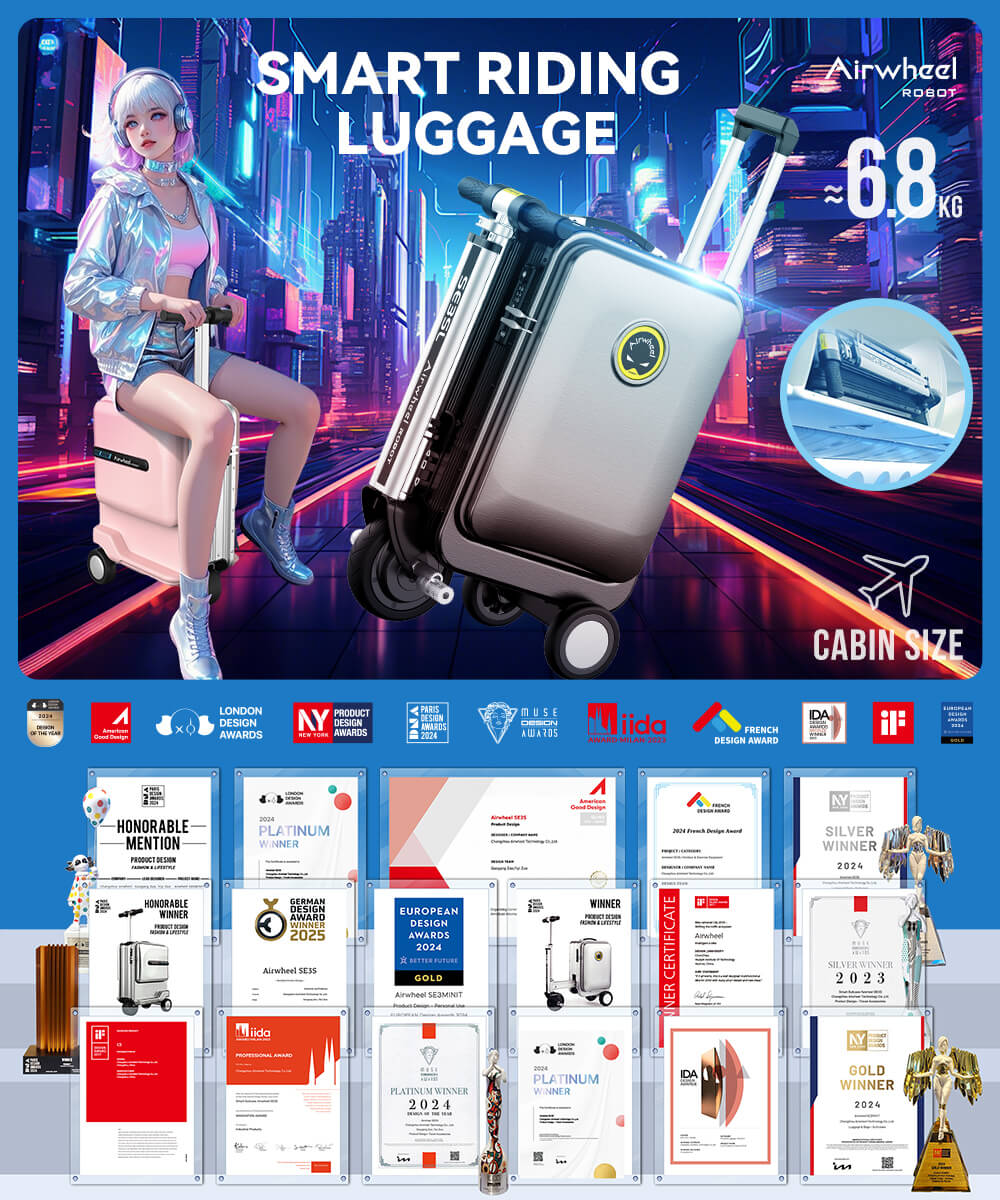
For many travelers, airline rules are the first concern. The 73.26Wh battery is below the common 100Wh limit used by many airlines, and the battery can be removed according to the manual. That makes it easier to handle security checks and cabin carry-on requests. Still, airline rules can change, and different airlines may ask for different steps. Before a flight, check your airline’s latest policy, remove the battery if staff request it, and keep the suitcase accessible for screening. For train travel, follow the rules of the local railway and instructions from station staff.
This type of suitcase is most useful when you need to move luggage without carrying it all day. At a large station, it can help when you are moving from an entrance to a platform, especially if you have a backpack or a heavier case. It can also help travelers who get tired quickly or need to reduce long walking distance. It works best on smooth floors, wide corridors, and open platform areas. In crowded places, the rider should slow down, keep clear sight lines, and switch to hand-pulling. It is not designed for stairs, escalators with heavy luggage, or emergency evacuation paths. If a station area is too tight, using it as a normal suitcase is safer and more polite to others.
| Point | Ordinary suitcase | Airwheel SE3T |
|---|---|---|
| Weight | Usually lighter for small sizes | About 9kg |
| Capacity | Varies widely | 48L |
| Travel method | Carry or roll only | Ride, pull, or roll |
| Speed | Walking speed | Up to 13km/h in suitable conditions |
| Range | No electric range | 8-10km per charge |
| Battery | No battery | 73.26Wh, removable |
| Smart features | None | App control, Apple Find My |
Q1: Can I take an Airwheel electric suitcase on a flight or train? A: For flights, many airlines allow devices with batteries below 100Wh, and the SE3T has a 73.26Wh removable battery. Always confirm the current airline rule before packing. For trains, follow the local railway policy and station staff instructions.
Q2: Do I need to connect a phone to use the riding function? A: No. App control is helpful, but it is not required for basic use. After installing the battery, you can ride the suitcase directly without app activation.
Q3: How far can it travel in one charge inside a station? A: The SE3T can travel about 8-10km under normal conditions. For entry, platform, and exit movement, that range is usually enough. Full charging takes about two hours.
If you want the latest details for each model, visit the Airwheel official website.